
Choosing the foundations of our digital future
When we decided to move away from Shopify and build our own ecommerce platform, we faced an important decision: what technology should we build it with?
There are numerous programming languages, frameworks and ecommerce systems available, each with its own strengths and limitations.
For Bunyip Hemp, the decision wasn't about choosing the newest technology, following industry trends or building the most technically impressive website.
It was about choosing a reliable foundation that could support the business we operate today and the business we intend to become.
We chose Laravel.
What is Laravel?
Laravel is an open-source web application framework built using the PHP programming language.
Unlike Shopify, Laravel isn't a ready-made online shop. It provides developers with the tools and foundations necessary to build their own web applications.
Think of it as the difference between renting a shop in a shopping centre and constructing your own commercial premises.
The former provides convenience and an established environment. The latter gives you considerably more freedom to determine how everything works, but also comes with greater responsibility.
Laravel provides the foundations upon which we can build our own digital business infrastructure.
Open-source technology and business independence
One of the most important considerations for us was that Laravel is open-source software.
We can inspect its source code, modify our application, choose where it is hosted and determine how it operates.
We are not dependent upon a single ecommerce platform provider to approve new functionality, establish pricing structures or determine how we conduct our business.
We also have the freedom to choose other compatible open-source technologies and integrate them into our platform.
This doesn't eliminate every technological dependency, but it gives us considerably more control over them.
For an independent Australian business, that matters.
Building around our business
Bunyip Hemp is more than an online shop.
Our business encompasses retail customers, wholesale customers, stockists, markets, events, affiliates, customer referrals, product development and educational content.
Each of these activities has different operational requirements.
Rather than purchasing numerous additional applications and trying to make them work together, we wanted a cohesive platform that could accommodate our business as a whole.
Laravel allows us to develop functionality around our actual requirements, including:
Retail and wholesale ecommerce.
Product and inventory management.
Multiple inventory and fulfilment locations.
Affiliate and customer referral programmes.
Customer accounts and guest checkout.
Events and promotional campaigns.
Stockist management.
Transactional communications.
Educational articles and scientific resources.
Business administration and reporting.
Some of these capabilities are already operational, while others will continue to evolve as our business grows.
The objective is not to build another Shopify. It is to build a platform specifically for Bunyip Hemp.
Not reinventing the wheel
Building our own ecommerce platform doesn't mean writing every piece of software from scratch.
One of Laravel's greatest strengths is its extensive ecosystem of established open-source software.
Our platform combines several complementary technologies:
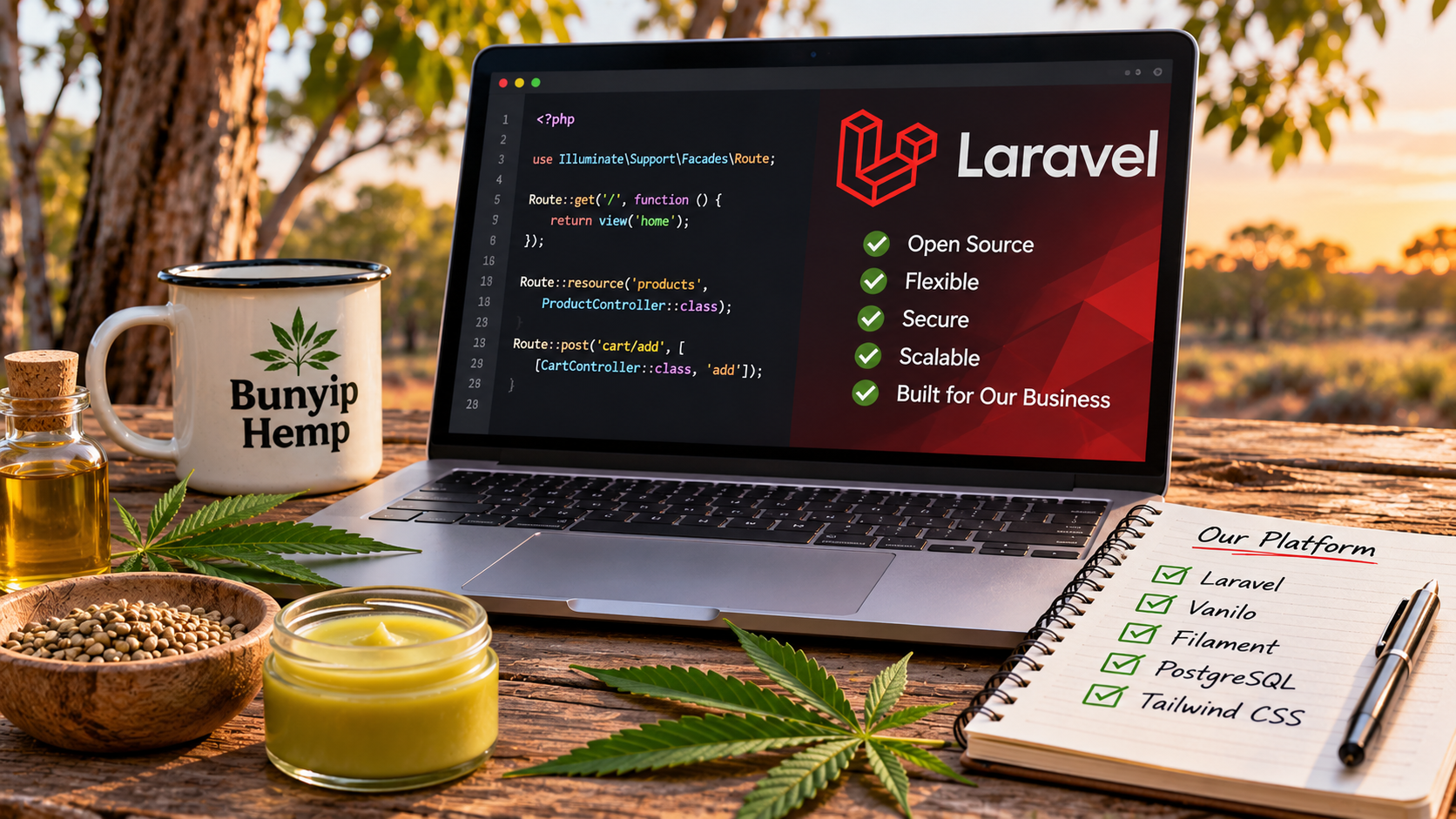
Laravel – The central application framework that provides the foundations for authentication, validation, business processes, communication and application security.
Vanilo – An open-source ecommerce framework that provides many of the fundamental components required to operate an online store.
Filament – A framework that enables us to build comprehensive business administration interfaces.
PostgreSQL – A mature open-source relational database system responsible for storing and managing our core business information.
Blade and Tailwind CSS – Technologies that help us build a consistent, responsive and accessible customer-facing website.
By combining established technologies with our own business-specific functionality, we can concentrate our development efforts where they provide genuine value.
There is little benefit in rebuilding something that already works well.
Keeping things simple
Modern software development can become extraordinarily complicated.
It is possible to build a relatively ordinary website using dozens of interconnected services, databases, applications and infrastructure components.
Every additional component creates another potential point of failure, another maintenance obligation and another security consideration.
We wanted to avoid unnecessary complexity.
One of the fundamental architectural principles behind the Bunyip Hemp platform is:
The smallest complete system that supports Bunyip Hemp's actual business operations, without unnecessary infrastructure, duplicated functionality or avoidable maintenance.
Laravel allows us to build a cohesive application in which related business functions operate together.
Our development philosophy is equally straightforward:
Preserve what works.
Extend what is necessary.
Replace only what is demonstrably inadequate.
Avoid adding functionality without an identifiable purpose.
We believe that simplicity, when achieved through thoughtful engineering, is a strength rather than a limitation.
Getting the important things right
An ecommerce website needs to do considerably more than display products and accept orders.
Behind every purchase are numerous processes that must operate correctly.
Inventory must be accurate. Prices must be calculated consistently. Orders must be recorded reliably. Discounts must be applied correctly. Customer information must be protected.
A customer should not be able to purchase stock that is no longer available simply because two people placed orders at the same time.
An accidental double-click should not result in two separate orders.
A completed purchase should not silently change because a promotion subsequently expires.
These are examples of the less visible engineering considerations involved in developing a reliable ecommerce platform.
Laravel and PostgreSQL provide us with tools to address these challenges through structured business rules, database transactions, validation and automated testing.
Getting these details right is considerably more important than adding flashy website features.
Customer privacy by design
Building our own platform also gives us greater control over how we manage customer information.
We can determine what information is necessary to conduct a transaction, how it is stored, when it is used and how customers manage their communication preferences.
We can distinguish between transactional communications and promotional emails.
We can allow customers to purchase without creating an account.
We can make deliberate decisions about tracking technologies rather than automatically adopting whatever is included in a commercial application.
Our approach to customer privacy begins with a simple principle:
Collect information because it serves a legitimate purpose, not simply because the technology makes it possible.
Laravel gives us the flexibility to incorporate that principle into the design of our application.
Security is a responsibility, not a feature
Operating our own platform means accepting greater responsibility for its security and reliability.
Laravel provides established mechanisms for authentication, authorisation, password hashing, input validation and protection against several common web application vulnerabilities.
However, using a reputable framework does not automatically make a website secure.
Security also requires responsible development practices, ongoing maintenance, software updates, appropriate access controls, testing, monitoring, backups and recovery procedures.
These considerations form an important part of our development and operational specifications.
We recognise that greater independence comes with greater responsibility.
Building for the future
Perhaps the greatest benefit of choosing Laravel is the freedom it gives us to develop our business over time.
If we identify a better way to support wholesale customers, we can develop it.
If we discover a more effective way to connect our market customers with our online store, we can implement it.
If we want to introduce new product bundles, improve our affiliate programme or build a comprehensive hemp knowledge centre, we have a foundation upon which to do so.
We don't have to wait for an external platform provider to introduce the functionality we need.
Nor do we have to build everything immediately.
We can develop our platform incrementally, adding commercially useful functionality when it is needed and when we are ready to support it properly.
Technology should serve the business
It is easy to become distracted by technology for its own sake.
Our customers are not particularly concerned about which programming language we use, which database stores their orders or which software framework powers our website.
And nor should they be.
They want to find products, access useful information, place orders, receive what they purchased and deal with a business they can trust.
Technology should make those things easier.
That is why one of our guiding architectural principles is particularly simple:
Laravel exists to serve Bunyip Hemp. Bunyip Hemp does not exist to serve Laravel.
The technology is a means to an end, not the end itself.
An investment in independence
Choosing Laravel was ultimately a decision about the kind of business we want Bunyip Hemp to become.
We want to remain independent, retain control over our business systems, respect our customers, support other independent Australian businesses and continually improve what we do.
Building our own platform requires time, effort and technical discipline.
But every improvement becomes part of something we own, something we understand and something we can continue developing.
We are not simply building a website.
We are building the digital foundations of an independent Australian business.
And that is why we chose Laravel.
Join the conversation
Comments
Have a question or something to share? We'd love to hear from you.