

Exploring cannabidiol, the endocannabinoid system, serotonin signalling and the evidence behind full-spectrum hemp extracts.
Anxiety affects millions of people worldwide, ranging from occasional stress-related symptoms to persistent anxiety disorders that interfere with daily life. Alongside established approaches such as psychological therapies and medication, researchers have investigated cannabidiol (CBD) for its potential effects on anxiety and the biological mechanisms involved.
Several human studies have reported promising results. However, understanding those findings requires distinguishing CBD itself from full-spectrum hemp extracts and recognising where clinical evidence remains limited.
What Is Full-Spectrum CBD?
Full-spectrum CBD is a cannabis-derived extract containing cannabidiol alongside other naturally occurring plant constituents. Depending on the formulation, these may include:
Minor cannabinoids, such as cannabigerol (CBG) and cannabichromene (CBC).
Terpenes, including compounds such as myrcene and linalool.
Flavonoids and other plant constituents.
Varying amounts of tetrahydrocannabinol (THC), where present.
This differs from CBD isolate, which consists predominantly of cannabidiol.
Researchers have investigated whether combinations of plant constituents can influence one another's pharmacological effects. This is commonly called the entourage effect.
Although experimental findings provide reasons to investigate these interactions, the clinical advantages of full-spectrum extracts over purified CBD have not yet been conclusively demonstrated for anxiety disorders. [4]
The Science Behind CBD and Anxiety
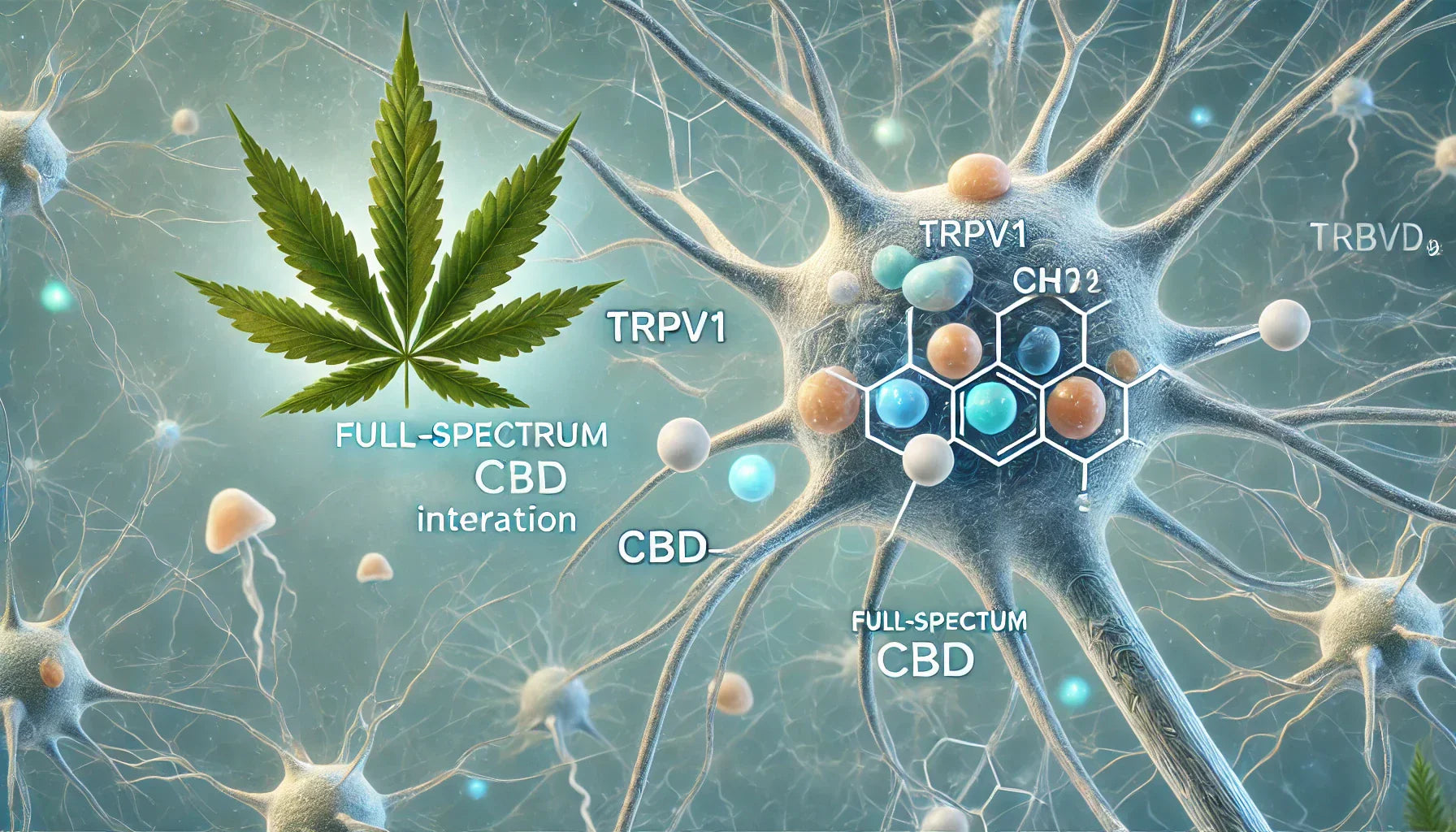
CBD interacts with several biological signalling systems relevant to emotional processing, stress responses and neuronal activity.
Research has examined its relationship with the endocannabinoid system, serotonin receptors and brain regions involved in fear and anxiety.
1. Serotonin Signalling and the 5-HT1A Receptor
The 5-HT1A receptor belongs to the serotonin receptor family and participates in processes associated with mood, anxiety and stress regulation.
Pharmacological research indicates that CBD can influence signalling associated with this receptor.
Blessing and colleagues reviewed preclinical and clinical studies investigating CBD's potential anxiolytic mechanisms, including serotonergic pathways. The authors identified promising evidence while emphasising the need for larger human clinical trials. [2]
This research supports investigating CBD's effects on serotonin-related signalling. It does not establish that CBD simply increases serotonin concentrations or corrects a single underlying chemical imbalance.
2. Amygdala Activity and Emotional Processing
The amygdala is involved in processing emotionally significant stimuli, including potential threats.
In a human functional MRI study, Fusar-Poli and colleagues investigated the effects of CBD and THC on neural responses during emotional processing.
CBD was associated with reduced activation in the amygdala and related brain regions in response to fearful stimuli, whereas THC produced a different pattern of effects. [3]
These findings demonstrate that CBD can influence measurable neural processes associated with anxiety and fear.
However, changes in brain activation do not, by themselves, prove sustained treatment benefits for people with anxiety disorders.
3. Human Clinical Research on Anxiety
One frequently cited study was conducted by Bergamaschi and colleagues in 2011.
The researchers investigated 24 treatment-naïve people with social anxiety disorder who received either a single 600 mg dose of CBD or placebo before a simulated public-speaking task.
Participants receiving CBD reported significantly reduced anxiety, cognitive impairment and discomfort compared with those receiving placebo during the experimental procedure. [1]
The findings were encouraging because they demonstrated measurable effects in a controlled human study.
However, this investigation used highly purified CBD and examined the effects of a single dose in a specific experimental setting.
It did not evaluate the long-term treatment of anxiety disorders or establish equivalent results for commercially available full-spectrum extracts.
A 2024 systematic review of randomised clinical trials examined CBD across different anxiety-related conditions. The review identified promising findings, alongside important limitations involving study design, participant numbers, doses and the consistency of results. [5]
The accumulated evidence supports further clinical investigation, but it does not establish CBD as a universally effective treatment for anxiety.
The Entourage Effect: Do Other Hemp Compounds Matter?
Full-spectrum extracts contain additional plant constituents that may possess biological activity.
For example, terpenes such as linalool and myrcene have attracted scientific interest because of their pharmacological properties.
Researchers have investigated whether terpenes and cannabinoids can interact to alter biological effects.
A comprehensive review published in 2024 examined experimental and clinical evidence concerning these potential interactions. The authors concluded that further well-designed clinical studies are necessary to establish whether terpene combinations provide meaningful therapeutic advantages. [4]
This distinction is important.
The entourage effect is a legitimate subject of scientific investigation, but it should not be treated as proof that every full-spectrum CBD preparation provides stronger anxiety relief than purified CBD.
The outcome may depend on the specific compounds, their concentrations, interactions, administration route and individual response.
CBD, Anxiety and Sleep
Anxiety and sleep difficulties often occur together. Sleep disturbance can intensify anxiety symptoms, while persistent worry can interfere with falling or staying asleep.
Because CBD is being investigated for anxiety-related effects, researchers have also studied its possible influence on sleep.
Results have been mixed.
For example, a 2024 randomised pilot trial investigated 150 mg of CBD nightly in 30 adults with moderate-to-severe insomnia. The findings did not demonstrate a consistent, broad improvement across sleep outcomes compared with placebo. [6]
Other investigations have explored different formulations and participant groups.
These studies demonstrate why results from one formulation or condition should not automatically be applied to another.
Further research is needed to establish which individuals, if any, may experience reliable sleep benefits from specific CBD preparations.
What Are the Potential Benefits of CBD for Anxiety?
The published literature provides several reasons for continued investigation:
Anxiety during stressful situations: Controlled human studies have reported reductions in experimentally induced anxiety following CBD administration. [1]
Emotional processing: Neuroimaging research demonstrates measurable effects on brain activity associated with threatening or fearful stimuli. [3]
Multiple pharmacological pathways: CBD interacts with several biological systems involved in neuronal signalling, providing plausible mechanisms for further study. [2]
Potential clinical applications: Systematic reviews have identified promising findings while recognising that larger, longer and more consistent trials are still required. [5]
These findings are scientifically meaningful, but their implications should be interpreted within the conditions in which they were demonstrated.
What About Safety?
CBD has generally been regarded as having relatively low abuse potential compared with many intoxicating substances. Nevertheless, low abuse potential does not mean that every CBD-containing preparation is risk-free.
Research and pharmacovigilance have identified potential adverse effects, medication interactions and, particularly at some therapeutic doses, elevations in liver enzymes.
Products containing THC also have considerations that do not apply to purified CBD alone.
The concentration, formulation, route of administration, dose and individual circumstances can all influence safety.
People considering cannabinoid-based treatments for anxiety should seek appropriate advice from a qualified healthcare professional, particularly when taking prescription medicines or managing existing health conditions.
How Have Researchers Administered CBD?
Clinical investigations have used different CBD formulations and administration methods, including oral solutions, capsules and other preparations.
These differences are scientifically important because the amount absorbed and the timing of exposure can vary substantially.
The 600 mg dose used in the Bergamaschi public-speaking study, for example, was a research dose administered under controlled conditions. It should not be interpreted as a general consumer dosing recommendation. [1]
Existing studies do not establish a universally appropriate dose, administration schedule or preferred commercial formulation for treating anxiety.
Understanding the Evidence for Full-Spectrum CBD
When reviewing research on CBD and anxiety, four questions are particularly useful:
Which substance was studied? Purified cannabidiol, a CBD-dominant extract or a preparation containing THC and other cannabinoids?
Who participated? Healthy volunteers, people with diagnosed anxiety disorders or participants in laboratory experiments?
What was measured? Temporary anxiety during a task, changes in brain activity, sleep outcomes or longer-term clinical symptoms?
How strong was the study? Was it randomised and placebo-controlled, and did it include enough participants to support reliable conclusions?
These distinctions help place individual findings within the wider scientific literature.
They are particularly important when interpreting evidence about full-spectrum preparations, because studies involving purified CBD do not automatically establish the effects of mixtures containing other cannabinoids and terpenes.
A Path Towards Better Understanding
CBD and anxiety remain active areas of scientific investigation.
Human clinical research has reported encouraging findings, and pharmacological studies have identified several mechanisms through which CBD may influence anxiety-related processes.
At the same time, important questions remain concerning longer-term outcomes, optimal formulations, individual responses and the clinical relevance of interactions between cannabinoids and terpenes.
Full-spectrum hemp extracts are scientifically interesting because they contain multiple biologically active constituents. Determining whether these combinations offer advantages for anxiety requires further controlled research using well-characterised preparations.
The evidence offers genuine reasons for scientific interest, while also demonstrating why the findings must be interpreted carefully.
Understanding both the results and the limitations of published research is essential to making informed assessments about CBD and its potential applications.
Scientific References
[1] Bergamaschi, M. M., et al. (2011). Cannabidiol reduces the anxiety induced by simulated public speaking in treatment-naïve social phobia patients. Neuropsychopharmacology, 36, 1219–1226.
https://doi.org/10.1038/npp.2011.6
[2] Blessing, E. M., Steenkamp, M. M., Manzanares, J., & Marmar, C. R. (2015). Cannabidiol as a potential treatment for anxiety disorders. Neurotherapeutics, 12, 825–836.
https://doi.org/10.1007/s13311-015-0387-1
[3] Fusar-Poli, P., et al. (2009). Distinct effects of Δ9-tetrahydrocannabinol and cannabidiol on neural activation during emotional processing. Archives of General Psychiatry, 66(1), 95–105.
https://doi.org/10.1001/archgenpsychiatry.2008.519
[4] The Entourage Effect in Cannabis Medicinal Products: A Comprehensive Review. (2024). Pharmaceuticals, 17(11), 1543.
https://doi.org/10.3390/ph17111543
[5] The Impact of Cannabidiol Treatment on Anxiety Disorders: A Systematic Review of Randomized Controlled Clinical Trials. (2024). Life, 14(11), 1373.
https://doi.org/10.3390/life14111373
[6] Cannabidiol for Moderate–Severe Insomnia: A Randomized Controlled Pilot Trial of 150 mg of Nightly Dosing. (2024). Journal of Clinical Sleep Medicine, 20(5), 753–763.
https://doi.org/10.5664/jcsm.10998
This article examines published scientific research for educational purposes. Findings from studies involving particular CBD formulations, doses or participant populations should not be assumed to apply to all cannabinoid-containing products. This discussion does not replace professional medical advice.

Join the conversation
Comments
Have a question or something to share? We'd love to hear from you.