
Looking beyond the leaf
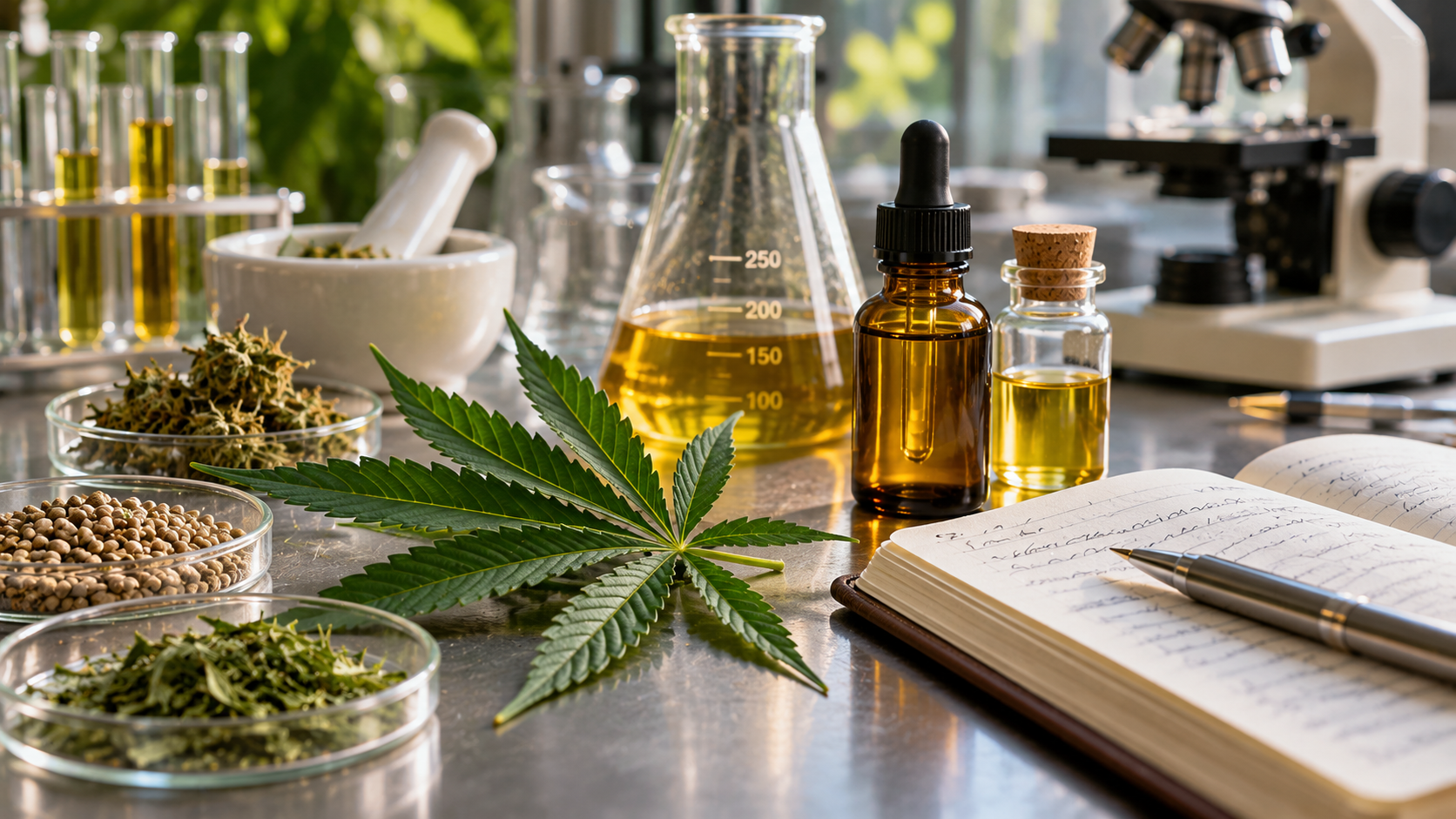
When most people look at a hemp plant, they see a distinctive green leaf. When I look at a hemp plant, I see an extraordinarily complex chemical system.
With a Bachelor of Applied Science in chemistry and microbiology, and a professional background in analytical chemistry and laboratory quality management, I approach hemp from a somewhat different perspective.
I'm interested in understanding what the plant contains, how its chemical constituents interact, what happens during processing and how those changes influence the composition of a finished product.
For me, hemp is a fascinating subject of scientific exploration.
Nature's chemical laboratory
Every plant is, in effect, a miniature chemical factory. Hemp is no exception.
Through a remarkable series of biochemical processes, hemp produces hundreds of naturally occurring chemical compounds, including:
Cannabinoids – a distinctive family of compounds that includes CBD, CBDA, CBG, CBGA and THC.
Terpenes – aromatic compounds also found in many other plants, including citrus fruits, lavender, rosemary and pine trees.
Flavonoids – plant compounds involved in pigmentation, protection and other biological functions.
Fatty acids – particularly abundant in hemp seeds, including omega-3 and omega-6 fatty acids.
Phytosterols – naturally occurring plant sterols.
Tocopherols – compounds belonging to the vitamin E family.
Chlorophylls – pigments essential to photosynthesis.
Proteins, carbohydrates and waxes – compounds that contribute to the structure and biological functions of the plant.
Each of these groups possesses different chemical properties, and each can behave differently during processing, extraction and storage.
Reducing hemp to a discussion about CBD alone overlooks much of what makes this plant scientifically interesting. [1, 2]
Not all hemp is chemically identical
One of the most interesting aspects of working with plant materials is their natural variability.
Two hemp plants may look almost identical yet possess substantially different chemical profiles.
Their composition can be influenced by numerous factors:
Plant genetics.
Soil composition.
Nutrient availability.
Water availability.
Environmental temperature.
Sunlight exposure.
Plant maturity.
Harvesting conditions.
Drying methods.
Storage conditions.
Unlike a pure chemical manufactured under tightly controlled industrial conditions, hemp is a biological material.
Its chemical composition is not necessarily constant.
From an analytical chemist's perspective, this presents both an interesting challenge and an important consideration when developing products.
Heat changes chemistry
One of the fundamental principles of chemistry is that temperature influences chemical reactions.
Hemp provides a particularly interesting example through a process known as decarboxylation.
Many cannabinoids occur naturally in the plant predominantly in their acidic forms. For example, cannabidiol (CBD) has an acidic precursor called cannabidiolic acid (CBDA).
During decarboxylation, the molecule loses carbon dioxide and its chemical structure changes.
However, decarboxylation is not the only chemical process that can occur when hemp is heated.
Depending on the processing conditions, heating may also result in:
The loss of volatile aromatic compounds.
Oxidation of certain chemical constituents.
Degradation of temperature-sensitive compounds.
Changes in the overall chemical composition.
Temperature, time and the surrounding chemical environment all matter. [3]
As a chemist, I find the relationship between processing conditions and finished product composition particularly interesting.
More heat is not necessarily better. Neither is less heat. It depends entirely on what you are trying to achieve.
Extraction is not simply extraction
Another fascinating aspect of hemp chemistry is extraction.
Different chemical compounds have different solubilities. Some dissolve readily in water, while others are more soluble in oils, alcohols or other solvents.
The choice of extraction medium, therefore, influences which compounds are transferred from the plant material into an extract.
Other factors, including temperature, processing time, particle size and the characteristics of the plant material, can also influence extraction.
This means that two extracts produced from the same hemp plant may have considerably different chemical compositions.
The term "hemp extract" alone tells us remarkably little about what is actually present.
It is a description of origin, not a complete description of chemical composition.
Ingredients matter
At Bunyip Hemp, we are interested not only in hemp itself but also in the ingredients with which it is combined.
Take olive oil and beeswax, for example.
Olive oil is itself a complex mixture containing triglycerides, fatty acid components and various minor chemical constituents.
Beeswax contains a mixture of esters, hydrocarbons, fatty acids and other naturally occurring compounds.
When ingredients are combined, their individual properties contribute to the characteristics of the finished formulation, including its:
Consistency.
Texture.
Stability.
Spreadability.
Resistance to oxidation.
Behaviour at different temperatures.
Even a product containing only a few ingredients can involve surprisingly complex chemistry.
This is one of the reasons we appreciate simplicity in product formulation. Every ingredient should have a purpose.
An unnecessarily complicated ingredient list does not automatically make a better product.
Natural does not mean chemical-free
One expression that always catches my attention as a chemist is "chemical-free".
There is no such thing as a chemical-free hemp product.
Water is a chemical substance. Oxygen is a chemical substance. Olive oil, beeswax and hemp are all composed of chemical substances.
Chemistry is not something separate from nature. Chemistry is fundamental to nature.
Equally, the fact that a substance occurs naturally does not automatically make it safe, beneficial or suitable for every application.
What matters is understanding:
What substances are present.
Their concentrations.
Their chemical properties.
How they interact.
How they are used.
What evidence supports their intended application.
The distinction between natural and synthetic may be relevant in particular circumstances, but it is not, by itself, a reliable measure of safety or quality.
Measurement matters more than assumptions
My background in analytical chemistry has taught me the importance of distinguishing between what we believe is present and what we can actually demonstrate is present.
The appearance, colour, aroma or consistency of a hemp product cannot reliably establish its complete chemical composition.
That requires appropriate analytical methods.
Techniques such as high-performance liquid chromatography (HPLC), gas chromatography (GC) and mass spectrometry (MS) allow scientists to separate, identify and quantify chemical constituents.
However, obtaining a laboratory result is only part of the process.
Sampling, calibration, analytical methodology, measurement uncertainty and quality control all influence the reliability of that result.
My experience in laboratory quality management reinforced something fundamental:
A measurement is only as trustworthy as the process used to obtain it.
That principle applies just as much to hemp as it does to any other material.
Separating science from marketing
The hemp industry is surrounded by an enormous amount of marketing, speculation, personal testimony and scientific research.
Unfortunately, these are not always clearly distinguished.
An interesting laboratory observation does not necessarily demonstrate a benefit in humans.
A personal experience, however remarkable, does not establish a universal outcome.
A proposed biological mechanism does not automatically establish clinical effectiveness.
And a scientific study investigating an isolated compound does not necessarily tell us how a finished product containing numerous different compounds will behave.
This does not mean that personal experiences or preliminary scientific findings are without value. They can provide interesting observations and generate questions worthy of further investigation.
But there is an important difference between an observation, a hypothesis and an established scientific conclusion.
At Bunyip Hemp, we believe those distinctions matter.
There is still much to discover
Despite the considerable research already undertaken into hemp, many interesting scientific questions remain.
How do different processing methods influence its chemical composition? How do individual constituents interact? How does storage affect different formulations? Which combinations of ingredients produce particular physical and chemical characteristics?
These are questions that deserve investigation rather than assumption.
One of the things I particularly enjoy about science is that answering one question often reveals several more.
Hemp is no different.
Our approach at Bunyip Hemp
At Bunyip Hemp, our approach is shaped by scientific curiosity, practical experience, thoughtful formulation and a commitment to continuous improvement.
We are interested in understanding our ingredients, questioning assumptions and exploring the science behind the products we develop.
We also want to share that knowledge with our customers.
Over time, we will be publishing articles exploring hemp chemistry, extraction, decarboxylation, carrier oils, formulation, analytical methods and other aspects of this remarkable plant.
Our intention is to make the science accessible without oversimplifying it or exaggerating what is known.
Because the more we understand hemp, the better equipped we are to make informed decisions about it.
And through the eyes of a chemist, there is an extraordinary amount to explore.
Nature provides the chemistry. Science helps us understand it.
Scientific references
Radwan et al. (2021). Cannabinoids, Phenolics, Terpenes and Alkaloids of Cannabis. Molecules.
Plant-Derived Compounds in Hemp Seeds (Cannabis sativa L.): Extraction, Identification and Bioactivity—A Review. Molecules (2025).
Wang et al. (2016). Decarboxylation Study of Acidic Cannabinoids: A Novel Approach Using Ultra-High-Performance Supercritical Fluid Chromatography/Photodiode Array-Mass Spectrometry. Cannabis and Cannabinoid Research, 1(1), 262–271.
Join the conversation
Comments
Have a question or something to share? We'd love to hear from you.